DataGlass is an e-commerce profit optimization platform that combines financial intelligence, predictive advertising models, and AI-powered workflows to help businesses understand and improve profitability.
Most marketplace advertising dashboards focus on attributed sales and ROAS. DataGlass incorporates your actual product economics and predictive campaign response models to optimize for expected contribution profit.
DataGlass supports Shopee, Lazada and TikTok Shop. Available features depend on the marketplace and campaign type.
DataGlass combines transactional data with product costs, commissions, transaction fees, discounts, fulfillment expenses, and advertising costs to reconstruct contribution profit at the product, order, and campaign levels.
DataGlass can automate supported budget, pacing, and Target ROAS decisions, using predictive models and configurable optimization constraints. Available controls depend on the marketplace and campaign type.
DataGlass is designed to operate within defined constraints and supported approval settings, allowing you to retain control over advertising decisions.
Connect your supported marketplace account, set your product costs, and allow DataGlass to synchronize the data needed for analysis. Actual setup and initial data processing times depend on your shop.
DataGlass supports multi-shop management for eligible accounts. Available access controls, reporting, and workflow capabilities depend on the subscription and supported marketplace integrations.
DataGlass Agent helps you explore shop data, investigate performance, identify opportunities, and prepare recommended actions. Some agentic workflows may be available only through pilot access.
DataGlass offers subscription options for different business needs, including growing sellers, brands, and agencies.
Yes. Every client sits in one workspace, and you switch between them or view all shops at once.
You set who approves what. Changes wait for approval unless you allow them to run automatically within limits.
Shopee, Lazada and TikTok Shop. Some features are available on only some of them, and the docs show which.
From each campaign's own spend and sales history, refreshed as new data arrives.
Yes. Every recommendation can wait for approval; automation is opt-in, per campaign, within limits.
Supported controls depend on the marketplace and campaign type.
Yes, for supported campaigns, based on forecast hourly demand.
Every change shows its expected profit, and the simulator tries changes without deploying them.
No. DataGlass shows plain answers and suggests the next step; the maths stays under the hood.
Shopee, Lazada and TikTok Shop. Some features are available on only some of them, and the docs show which.
Upload a sheet or type them in; DataGlass fills gaps with an estimate until you do.
Probably not. The agency runs the campaigns; DataGlass tells you whether the campaigns are profitable. Many shops keep the agency for execution and use DataGlass for the profit-aware decision layer above the agency's work.
Some agencies do model COGS and full economics; that is great. The difference is that DataGlass is the system of record for the seller. Switching agencies, expanding to a new platform, or running a multi-agency setup leaves the data and the decision layer intact.
No. DataGlass is built to complement the ERP. The ERP remains the financial system of record; DataGlass becomes the daily marketplace decision layer.
Direct two-way ERP integration is on the roadmap. Today the workflow is export-driven: DataGlass surfaces the decisions, the operator approves and acts, and reconciled data can be exported back to ERP-friendly formats.
Most ERP marketplace modules focus on order ingestion and inventory sync. They do not surface True ROAS, ad waste, or per-SKU contribution margin. Those are what DataGlass adds.
No. Listings, ads, order management, and customer messaging stay in Seller Center. DataGlass is the analytics and decision layer that sits above all three platforms.
Selected actions, yes. Pricing changes and ad-spend adjustments are surfaced as one-click recommendations that write back to Shopee via the platform's authorized APIs. Other actions are read-only for now.
DataGlass does not run ads. It evaluates the campaigns Shopee is already running against your real margin and surfaces the budget moves that grow profit. Bid changes are deployed via Shopee's native ad system.
No. Most teams keep a planning spreadsheet for things DataGlass does not yet do. The bulk of the per-day reporting and decision work is what moves into DataGlass.
Yes. Every view supports CSV/XLSX export so the work that still belongs in a spreadsheet stays one click away.
The cleanest comparison is hours per week. A seller running three shops typically spends 4–8 hours a week joining and reconciling marketplace data. DataGlass takes that to under one. The remaining hours go into decisions, not data prep.
E-commerce profit optimization is choosing the values of the decisions you control — ad target, ad budget, price, assortment, and stock — so as to maximise contribution after every real cost, subject to the constraints that bind each decision. It differs from e-commerce analytics in that analytics reports a state and optimization selects an action, and it differs from following platform recommendations in that marketplaces optimize gross merchandise value, which is the base they charge commission on, rather than your profit. In practice the hard part is not the optimization but the objective: contribution per order line has to be reconstructed from cost of goods, category commission, transaction and payment fees, seller-funded vouchers, the free-shipping cost share, fulfillment, and a returns reserve before any decision can be scored against it.
The same five decisions apply, with one Shopee-specific starting point: contribution per SKU after category commission, transaction and payment fees, vouchers, the free-shipping cost share and returns — which gives break-even ROAS as one divided by that margin. Treat break-even as the zero line rather than a floor, because a target set there permits a bid equal to the whole contribution of a click. The full Shopee playbook, with the worked example and the operator checklist, is the Increase Shopee profit pillar linked from this page.
Because they are optimal for a different objective. Marketplaces earn commission on gross merchandise value, so their ad systems, their campaign suggestions and their bid recommendations are tuned to maximise GMV — which is why the flagship Shopee campaign type is called GMV Max. Maximising GMV and maximising profit coincide only when contribution margin is constant across everything you sell, which it never is. A recommendation that lifts GMV by pushing volume into low-margin SKUs, or by lowering an ad target below break-even, is doing exactly what it was designed to do while making you poorer.
Only after the same product is one row rather than three. Shopee, Lazada and TikTok Shop each carry their own fee schedules, voucher mechanics, attribution windows and cost-share rules, so the identical unit can hold materially different contribution on each. Optimizing per platform in isolation therefore produces a portfolio that is locally sensible and globally wrong — most obviously in budget allocation, where the correct rule is to equalise marginal return across platforms rather than to hit a target on each. DataGlass builds a canonical catalogue across the three, computes contribution on each binding, and ranks moves against one objective.
Revenue and profit move together only while contribution margin is positive and roughly constant, and neither condition survives contact with a real marketplace catalogue. In the worked example on our blog, a campaign whose Target ROAS is set two points below break-even posts the largest GMV of any configuration tested — four and a half times the profit-optimal one — and loses THB 6,173 a day doing it. Every visible metric improves as the campaign walks off the cliff. That is the general shape of the problem: revenue is observable and profit is not, so optimizing what you can see is a reliable way to lose money slowly.
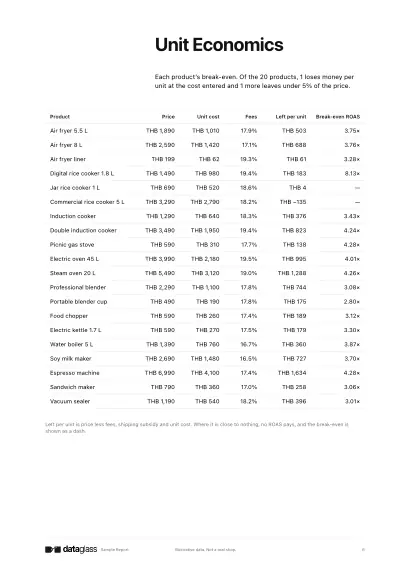
For every order, DataGlass deducts COGS, marketplace fees (Shopee commission fee, Lazada platform fee, TikTok Shop transaction fee), attributed ad cost, fulfillment, and any seller-funded vouchers from revenue. The result is a per-order profit breakdown that rolls up into contribution margin per SKU — the per-unit profit that funds the business.
Yes. Every Shopee, Lazada, and TikTok Shop platform fee is modeled per category and per program — commission fee, transaction fee, payment-processing fee, free-shipping subsidy, and seller-funded voucher. The profit breakdown shows each line so the math is auditable per SKU.
Yes. Upload what you have via CSV or XLSX with column auto-mapping. For SKUs without a COGS, DataGlass infers a starting estimate and flags it so you can refine it over time. The profit calculator still produces a directional profit insight while you fill the gaps.
Gross margin only deducts COGS from revenue. Contribution margin also deducts marketplace fees (commission, transaction, platform structure), ad cost per unit, fulfillment, and vouchers — it reflects real per-unit economics on a marketplace and is the number the DataGlass profit breakdown surfaces.
Yes. Every voucher and flash sale is reconciled against per-SKU contribution margin so you see whether it lifted profit, just lifted GMV, or destroyed margin.
Yes. The bundle-margin projector models contribution margin of each bundle composition before you publish, including the attach-SKU mix and the platform fee impact.
Not yet. DataGlass surfaces the recommended promotion structure and you publish via the platform native flow. Auto-publish is on the roadmap.
Platform dashboards show attributed revenue. DataGlass shows profit after fees, COGS, vouchers, and fulfillment — the actual number that determines whether the campaign was worth running.
Yes, for the campaigns you put in an optimization group. On Shopee and on TikTok Shop GMV Max, DataGlass sets each campaign’s budget every night from expected profit, steps budgets through the day through each platform’s official API, and proposes a margin-based Target ROAS you apply in one click. Every change is logged with its reason, and you can pause a group or switch a shop to read-only at any time.
Profit-aware bid adjustments target campaigns and keywords that are losing money, not the ones driving organic ranking. DataGlass shows the trade-off explicitly so the decision is informed.
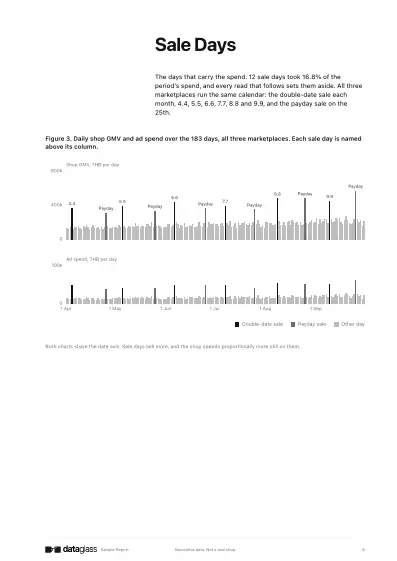
Yes. The stockout-day model accounts for scheduled campaign windows (11.11, 12.12, Pay Day, Lazada flash sales) and TikTok Shop live events that historically lift demand on specific SKUs.
Yes. The canonical product catalog binds the same product across Shopee shops and platforms so inventory state is one number, not per-listing. Opt-in writeback keeps Shopee total_stock in sync.
Not yet. DataGlass surfaces a ranked restock list with the recommended quantity and lead time; PO creation is on the roadmap.
See it on your shop
Book a 30-minute demo. We walk through DataGlass on your own Shopee, Lazada and TikTok Shop data, and you get 14 more days to try DataGlass free.
Get your shop report
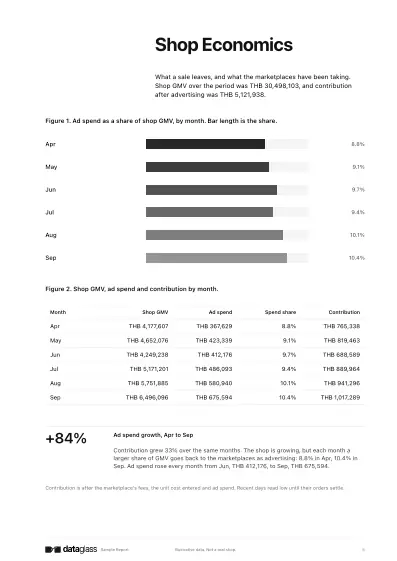
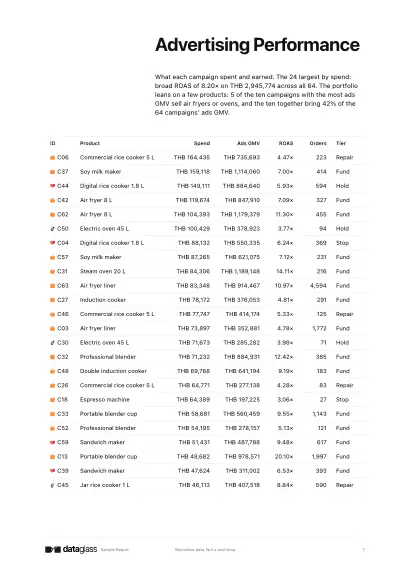
Our team prepares a free report on your shop's unit economics and ads.
View a sample reportStart for free
Connect your shops and act on every decision DataGlass ranks for you.